
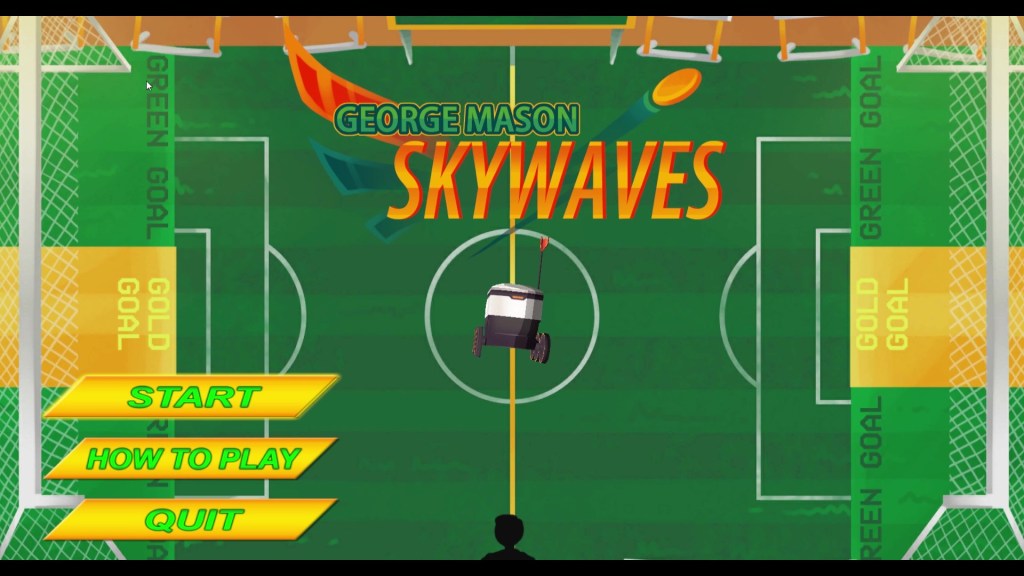
GMU Skywaves is a clone of the game Windjammers I made in Fall 2019 alongside 20-30 other game development students in a five month period of time.
My tasks were as follows:
- manage the game design department and assign work
- study the source game to better design mechanics for the clone game
- take lead on testing and debugging
- communicate with other departments (art/sound/programming) to make sure everyone is on the same page
GMU Skywaves is essentially a really advanced game of Pong. It involves two players throwing a bouncy frisbee around an arena with the purpose of hitting the opponent’s goal enough times to win. There are four different characters with different stats, much like the original Windjammers. Unlike the original Windjammers, Skywaves features some newness in the form of special abilities, which takes the place of the super tosses found in the original game.
The production for this game was overall an incredible experience. The different departments were all very talkative with one another and everyone was constantly stepping up to help bring the game to life from whatever role they were in. As the design manager and the lead of design for the game’s mechanics I got to thoroughly investigate Windjammers mechanics and all of its subtle little details. This was especially helpful when it came time to debug and test the game out since I always got a funny feeling whenever something didn’t play the way it supposed to. With the help of an incredible group of programmers the design team was able to produce a suitable recreation of the original Windjammers game, with an extra dose of life brought into it thanks to the art and sounds teams.
While working on this project I learned a lot of new things about game development. This was the biggest project that I got to work on during my time at George Mason University and as such it gave me a lot of experience with working with others. I think the thing I struggled with the most was not being able to directly change the code myself whenever I saw a problem. Instead I had to make changes to the game almost entirely through documentation and my communication with the other departments, which was a really new experience compared to smaller projects where I can help out with essentially everything. Beyond that I also learned how to keep my cool during crunch and how to always find new work for my teammates and I to do.
If nothing else, my biggest takeaway from the project is that the simplest way of ensuring a game’s success is to play it every single day until its finished. Not only does this make it easy to find proposed changes that need documentation, but it also helps to give a really good feel for the most important changes that need to be made. This project was a blast to work on and it makes me excited to work in really big teams again in the future!
 Darren Walsh